

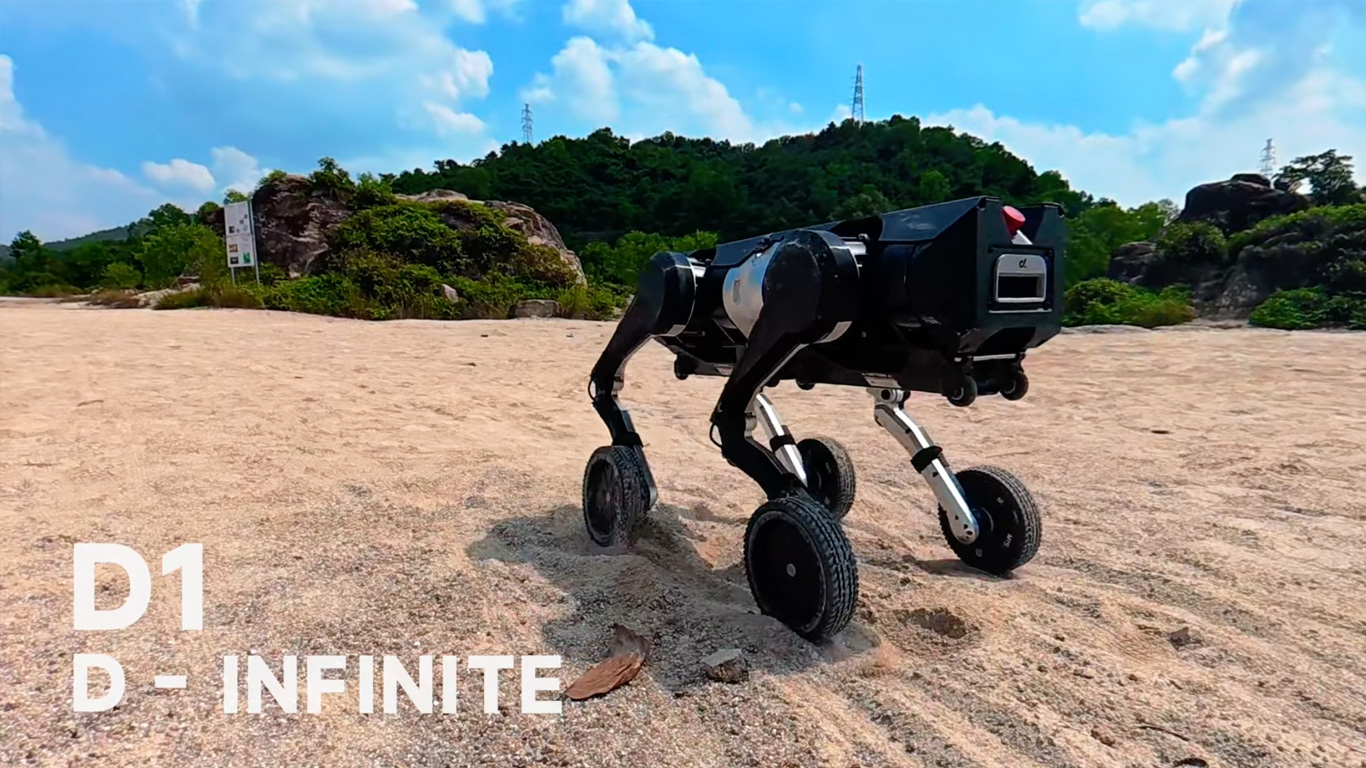
China just unveiled something that feels straight out of a sci-fi movie and it’s real. Meet D1, also known as D-Infinite, the world’s first fully modular robot developed by Direct Drive Tech in Beijing. This isn’t just another robotic innovation. The D1 represents a breakthrough in embodied intelligence, where machines cannot only think and move but also physically reconfigure themselves to adapt to the world around them. – Rajdeep Dam, Special Correspondent
A robot that redefines adaptability at its core, D1 is designed with modularity in mind. Each part of the robot functions as an independent unit called a module that can connect or disconnect in seconds. Using a system of snapping joints and smart connectors, these modules can rearrange themselves into wheels, legs, or other functional components depending on the task at hand.
Need speed? It rolls. Need stability? It crawls or stands. Need strength? It merges with other modules to form a powerful unit capable of heavy lifting or terrain navigation.
This dynamic flexibility allows D1 to adapt to nearly any environment or challenge something that static, single-form robots simply cannot do. Built for performance, not just show, the concept sounds futuristic, the D1 is a fully functional machine ready for real-world deployment. With a load capacity of 100 kilograms, five-hour endurance, and an operational range of 25 kilometers, it’s built for both performance and resilience.
The potential applications are vast:
- Disaster response, where modular robots can traverse debris, climb obstacles, and carry supplies.
- Construction and logistics, where robots can reconfigure themselves for different roles across a single site.
- Space exploration, where adaptability is key to surviving unpredictable terrain.
- Military and security operations, where flexible mobility could be the difference between success and failure.
D1 isn’t just a tool it’s a platform for innovation. A system that evolves with every mission. The rise of embodied intelligence, D1 made its public debut at China’s Embodied AI Robot Games in Wuxi, an event showcasing advancements that merge artificial intelligence with physical robotics.
What makes D1 so remarkable is that it bridges the gap between mechanical design and adaptive intelligence. Traditional robots follow fixed rules and perform predefined tasks. Embodied AI, however, gives machines the ability to perceive, learn, and adapt through physical interaction with their environment. This is where the D1 shines. It doesn’t just execute commands it responds to context. It can assess obstacles, choose the most efficient configuration, and even team up with other modules to perform complex operations autonomously.
From fiction to function, for decades, we’ve imagined shape-shifting robots in movies and games from Transformers to Iron Man’s nanotech armor. D1 is perhaps the first real-world step toward that vision. It represents more than technological progress it’s a shift in philosophy. Machines are no longer static tools, they are becoming living systems of logic and movement, capable of evolving their form to meet the needs of the moment.
The D1 shows us that robotics is no longer confined to rigid frames or factory floors. It’s entering a new era of creativity, adaptability, and intelligence one where the boundary between science fiction and reality grows thinner each day.
The future has already begun, this isn’t concept art. It’s happening now. As Direct Drive Tech continues to refine D1’s design and capabilities, the implications for industry, science, and society are profound. We’re witnessing the rise of machines that don’t just move they evolve. And as we look ahead, one thing becomes clear, in the world of robotics, infinite possibilities have just taken form.
[Report image, video courtesy Google, YouTube]